- Peatland GHG fluxes are currently estimated using static, category-based emissions factors (EFs)
- Following land-use change peatlands move directly from one category to another but this change is not instant in reality
- The current approach could miss transitional emissions and removals during the process of land-use change
- Inventory EFs for re-wetted peatlands indicate ongoing GHG emission (~3 t CO2e ha-1 yr-1) but recent data suggest successfully restored sites can rapidly become net GHG sinks (e.g. Figures 1-2)
Validating a model of transitional GHG fluxes and developing a methodology to support implementation in the IUCN UK Peatland Code and UK GHG Inventory
Background
Image
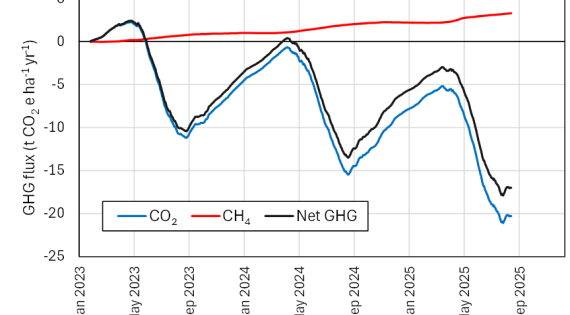
Fig 1. A reconstructed reedbed on a former gravel extraction site at RPSB Ouse Fen is acting as a strong GHG sink (UKCEH unpublished flux tower data, GGR Peat project)
Image
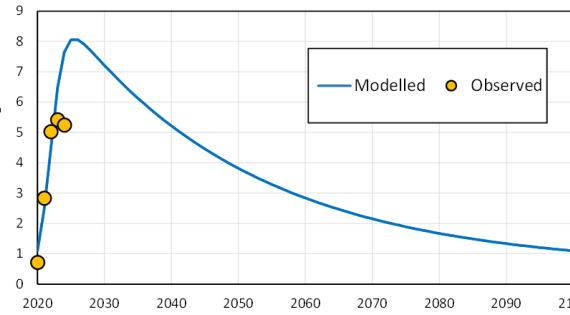
Fig 2. A restored peat extraction site in Moyarwood, Ireland with high initial sequestration (Wilson et al., 2022) modelled using a simple peatland mass balance model
- The UK Peatland Code only currently recognises emissions reductions from peat restoration, and other mechanisms (e.g. Science Based Targets Initiative) strongly favour emissions removals over reductions
- If an improving scientific evidence base shows successfully restored peatlands can act as net GHG sinks, this could support more extensive and effective restoration
- We will develop and validate an empirically-derived model to capture the effects of transitional processes on GHG fluxes for peatland ecosystems
What this means for the Peatland Code
If tree planting was accounted in the same way as peatland restoration, we wouldn’t count CO2 sequestered into trees during growth; we would only count carbon accumulated in the soil of old growth forests.
This project aims to produce an evidence-based methodology to include transitional GHG removals by restored peatland ecosystems in the Peatland Code.
This will improve consistency between the Peatland Code and the Woodland Carbon Code, and provide an improved scientific basis for UK peatland restoration.
Image
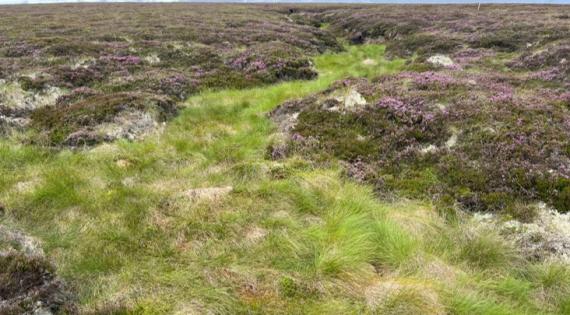
Revegetating gullies could be CO2 sequestration hotspots
Community Engagement
- One work-package specifically focuses on developing a site-level methodology for inclusion in the National Inventory and Peatland Code
- We will consider MRV requirements, project suitability criteria, method alignment and compatibility with other schemes
- A proposed methodology will be developed in Q1 2027
- We engage with stakeholders before finalising the methodology in Q4 2027
YOU COULD HELP (PLEASE)
We are currently building a list of Peatland Code stakeholders to provide feedback on our proposed methodology in 2027. We would like to hear from anyone whose work relates to National Inventory accounting or the Peatland Code; this includes, but not limited to, project developers, investors, researchers and policymakers.
If you would like to be involved please register your interest with the team here: https://forms.cloud.microsoft/e/NjGLNvspPn
In partnership
References
Simon et al. (2021). Greenhouse gas removal methods and their potential UK deployment.
Evans et al. (2022). Aligning the Peatland Code with the UK Peatland Inventory.